

Beyond the Prompt: How Domain Experts and MCP Enable Secure Connections Between Chatbots and Corporate Databases
From the AI Dilemma to the Standardized Solution: Introducing the Model Context Protocol (MCP)
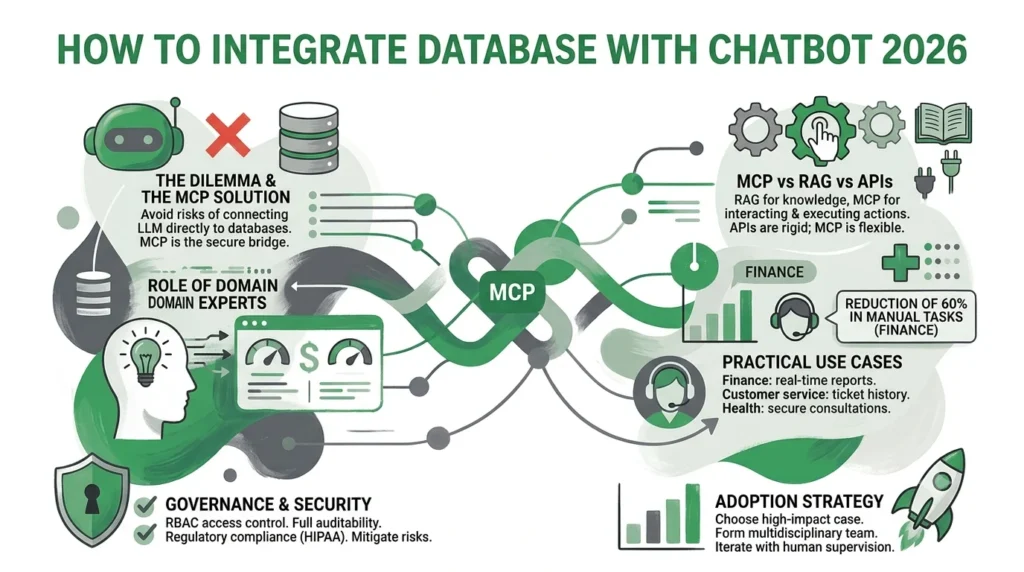
The proliferation of chatbots powered by artificial intelligence (AI) has presented organizations with a fundamental strategic dilemma: the power of natural conversation to interact with business systems versus the inherent risks of directly exposing critical data. On one hand, the promise is immense—transforming how employees access information, automate processes, and respond to customer needs. An employee could ask an internal assistant about an order status, a financial analyst could request a complex report without writing a single line of code, or a doctor could quickly search a patient’s medical history. However, executing this vision by simply connecting a large language model (LLM) to an existing enterprise database is an extremely risky and unreliable practice. Potential consequences include security policy violations, generation of incorrect SQL queries that compromise data integrity, and non-compliance with data privacy regulations such as GDPR and CCPA. It is in this context that the Model Context Protocol (MCP) emerges—not just as a technical solution, but as a new paradigm for enterprise integration.
The Model Context Protocol (MCP) is an open standard designed to standardize communication between AI models and external systems, such as databases, APIs, and software tools. Formally introduced in November 2024 by Anthropic, it has been described as the “HTTP of AI connectivity” —a universal protocol that defines a single message format for AI models to securely and structurally request and receive context. Its primary function is to act as an intermediary, or a secure bridge, mediating all interactions between an AI agent and the data resources it needs to function. This intermediary is not a mere passthrough; it is an active component of governance and control. By adopting MCP, companies can move from a “connection” architecture to a “governed integration” model, where access to information is always supervised, authorized, and logged.
To fully understand the value of MCP, it is crucial to differentiate it from related but complementary technologies, primarily Retrieval-Augmented Generation (RAG) . While RAG focuses on expanding an AI model’s knowledge by providing access to document-based knowledge bases (such as PDFs, websites, or internal knowledge bases) before generating a response, MCP focuses on an AI model’s ability to “take action.” RAG answers the question “what does the model know?”, while MCP answers “what can the model interact with?”. RAG is ideal for tasks requiring static, unstructured knowledge, such as answering questions about company policies or technical articles. On the other hand, MCP is optimized for accessing structured and real-time data, such as querying tables in a database, invoking functions from an API, or performing symbolic calculations on enterprise data. In practice, these two technologies are not mutually exclusive; in fact, they often work together. An AI agent might use RAG to understand the context of a user’s question (for example, what a specific acronym means in the business domain) and then use MCP to execute a precise query against a database to obtain the numerical data required for that question. The comparison also extends to traditional APIs. While APIs enable integration, each typically requires custom, vendor-specific development, resulting in fragile and difficult-to-maintain solutions at scale. MCP eliminates this dependency on custom integrations by providing a common interface, allowing the same AI agent to connect to a multitude of different systems without significant reprogramming.
The architecture of MCP is based on the concept of MCP Servers. An MCP Server is a backend service that implements the protocol and exposes a set of “tools” or capabilities to AI agents. These tools can be anything: a query to a specific table in a database, a call to an API endpoint to update a record, or even a complex mathematical operation on stored data. When an AI agent needs to perform an action, it does not connect directly to the underlying system; instead, it communicates with the MCP Server. First, the MCP Server informs the agent which tools are available, describing their names, parameters, and purpose. This allows the agent to dynamically decide which tool to call to fulfill the user’s request. Once it chooses a tool, it invokes it through the MCP protocol, passing the necessary parameters. The MCP Server receives the request, validates it, authorizes it according to defined security policies, and, if all is correct, executes it on the source system. The execution result is returned to the AI agent, which finally presents it to the user in a comprehensible format. This centralized architecture through the MCP Server is what enables consistent and scalable implementation of security and governance controls across the organization.
Adoption of MCP is gaining momentum at the enterprise level, with major players like OpenAI announcing compatibility in March 2025 and the protocol being donated to the Linux Foundation to become part of the Agentic AI Foundation, underscoring its nature as an open standard and collaborative effort for the future of AI. Pioneering companies are already implementing MCP to connect their AI platforms with critical systems. For example, Sentry, an error monitoring platform, implemented an MCP Server to directly integrate its AI system with its own monitoring platform, allowing developers to natively investigate complex issues. Oracle, for its part, is using MCP to enable AI agents that can translate natural language queries into precise SQL queries against its database, ensuring secure and governed data access. Plexara offers a platform that connects data platforms to AI agents through MCP, highlighting its role as the emerging standard for AI-data integration. These implementations demonstrate that MCP has already transcended theoretical concepts to become a practical tool for solving real business problems, from task automation to improving developer productivity. For business leaders, the transition to MCP represents a strategic opportunity to capitalize on the power of AI without sacrificing security, reliability, and control over the organization’s most valuable data assets.
| Feature | Retrieval-Augmented Generation (RAG) | Model Context Protocol (MCP) | Traditional APIs |
|---|---|---|---|
| Primary Purpose | Expand model knowledge with external knowledge bases. | Enable AI models to interact with tools and external systems. | Allow applications to communicate with each other. |
| Data Type | Generally unstructured (documents, text, web pages). | Optimized for structured and real-time data (databases, APIs). | Varies by API, but often focuses on structured data transfer. |
| Functionality | Retrieves relevant information to enrich model responses. | Executes actions, performs queries, and obtains dynamic results from external systems. | Provides access to predefined data and functionalities. |
| Flexibility | Less flexible; depends on the quality and availability of the retrieved knowledge base. | Highly flexible; allows agents to dynamically discover available tools. | Flexible but requires custom development for each integration. |
| Security | Reduces data memorization risks but introduces retrieval vulnerabilities. | Acts as a centralized security layer, enabling granular validation, authorization, and auditing. | Depends on the security implemented in each individual API. |
| Complementarity | Complementary to MCP; an agent can use RAG for knowledge and MCP for action. | Complementary to RAG; often used together in a complete AI agent. | Can be one of the systems that an MCP Server connects. |
The Hidden Architect: How Domain Experts Give Meaning and Security to AI
The true power of the Model Context Protocol (MCP) lies in its ability to go beyond a simple technical security layer and become a vehicle for transferring and applying an organization’s expert knowledge. The concept of “domain expert curation” is the differentiating element that transforms a generic AI integration into a cognitively extended and contextually intelligent tool. For a non-technical audience, it is essential to understand that domain experts—whether accountants, doctors, operations managers, or HR specialists—are not passive end-users of this technology, but rather the true architects and guardians of their wisdom. Their participation is indispensable to ensure that AI not only accesses data but also understands and uses it correctly and securely. This curation occurs at multiple levels, from configuring the tools exposed by the MCP Server to the deep injection of semantic knowledge into the AI model itself.
The first level of curation occurs when a domain expert defines and exposes a database or business system as a “tool” accessible through an MCP Server. This is not simply about opening a connection; it is a deliberate process of creating a secure contract between the data system and the AI agent. An expert, with the help of a developer, must specify which operations are safe, what types of queries are allowed, and, most importantly, how requests should be validated and authorized before execution. For example, a financial analyst curating an MCP Server to access the ERP database does not just expose the expense table; they define rules ensuring that any query made through that channel cannot modify data, only read it. They can also establish automatic filters based on roles, so that when a sales analyst queries expense data, the MCP Server automatically applies a filter to show only expenses related to the sales area, even if the user’s natural language query does not explicitly specify it. This process of “translating” the data system’s capabilities into a set of secure tools understandable by AI is a critical knowledge engineering task.
Beyond tool configuration, the domain expert’s role extends to creating a rich semantic environment that guides the language model. LLMs, while powerful, operate in a probability space and may lack the deep contextual understanding of a specific domain. This is where knowledge curation comes into play. Experts can contribute in several ways. One of the most effective is through creating representative examples and use cases. A marketing expert, for example, can provide a list of complex and nuanced questions that an experienced professional would ask about marketing campaigns. These examples are used to train or guide the LLM, teaching it not only the query syntax but also the intent behind the question and the type of relevant context it should seek. Spotify, in its data architecture, uses this approach to teach its AI models how to formulate queries against its databases, ensuring that responses are consistent with the practices and thinking patterns of its own data analysts.
Another crucial aspect of this semantic curation is the definition of ontologies and conceptual models that reflect business reality. A domain expert, together with data management professionals, can define the key entities of the company (customers, products, orders), their attributes, and the relationships between them, using precise and consistent terminology. This semantic model, often implemented as a knowledge graph, serves as a conceptual map for the AI agent, helping it navigate the database structure and understand how different data relates to each other. For example, an agent operating on an e-commerce ecosystem curated with a robust ontology will understand that “order” and “purchase” are related entities, and that a “repeat customer” is defined by certain behavioral patterns in their purchase history. This prior knowledge, injected by experts, dramatically improves the agent’s ability to interpret ambiguous user queries and perform complex logical inferences. Validation of simulated data during development is another way experts participate; they review generated synthetic data to ensure it accurately reflects domain assumptions and logic, preventing the model from learning erroneous patterns from the start.
Continuous collaboration between domain experts and AI systems is vital for maintaining and improving agent performance. Even after deployment, experts play a crucial role in the model lifecycle. They can review edge cases or incorrect responses generated by the agent, providing valuable feedback to adjust MCP tools, improve curation examples, or refine the underlying model. This human oversight ensures the agent remains aligned with changing business practices and corrects any performance deviations. The Framework for AI Software Technologies (FAST) at Mayo Clinic, for example, incorporates the identification and training of specialized personnel to manage the complete lifecycle of AI models, recognizing that success is not a one-time event but a continuous process of evaluation and improvement guided by expert knowledge.
This “fusion of domain knowledge with machine learning” approach has proven highly effective. A study in the Swedish public sector showed how collaboration between experts and data scientists in ML initiatives generated new knowledge and significantly improved the relevance and impact of the resulting models. Similarly, in another study, domain experts were crucial in guiding data scientists in optimizing machine learning models, ensuring the output was contextually relevant for subsequent use. For business leaders, this means that investing in the participation of domain experts is not a cost but a strategic investment. It is the only way to ensure that AI does not become an obscure and unreliable oracle but a powerful, accurate, and, above all, trustworthy assistant whose behavior is anchored in the accumulated wisdom of the organization itself.
Use Cases in Practice: Transformation in Finance, Healthcare, and Operations
The theory of the Model Context Protocol (MCP) and curation by domain experts finds its ultimate justification in tangible application to solve concrete business problems. Analyzing representative use cases in key industries such as finance, healthcare, and operations reveals how this technology is generating measurable impact on efficiency, decision-making, and customer experience. These examples demonstrate that integrating chatbots with existing databases through MCP is not a future possibility but a present reality redefining productivity in the modern workplace.
In the financial sector and within companies using enterprise resource planning (ERP) systems, the impact is particularly pronounced. Traditionally, financial analysts spend considerable time extracting, cleaning, and manipulating data from various sources to prepare reports and analysis. Implementing an MCP-governed chatbot can revolutionize this workflow. Imagine a financial analyst asking an internal AI assistant: “What was the total marketing spend for product X in the last quarter, broken down by region, and how does it compare to the allocated budget?” Previously, this request would have required exporting data from the ERP database, importing it into a spreadsheet, writing complex formulas, and waiting for IT teams to generate a custom report. With MCP, the process is radically different. The chatbot, connected through an MCP Server carefully configured by an expert accountant, interprets the user’s question. The MCP Server validates that the requested query is legitimate and does not attempt to modify sensitive data. Then, it applies role-based access control (RBAC) to ensure the analyst only has access to data from their corresponding division. Finally, the server translates the request into a precise SQL query and executes it directly against the ERP database in real-time, returning a clear and visually appealing summary. The strategic impact of this capability is significant: repetitive manual tasks can be reduced by an estimated 60%, achieving returns on investment between 250% and 400% by freeing analysts to focus on strategic data interpretation rather than raw data collection. Moreover, this approach ensures all analysis is based on fresh, consistent data, dramatically improving the quality and speed of decision-making.
In customer service and technical support, integrating chatbots with CRM databases and service management systems via MCP is also proving highly effective. Support agents often face the challenge of jumping between multiple screens to gather all the information needed to resolve a customer issue. An agent, upon receiving a complex ticket, can now simply ask their AI chatbot: “Please check the customer’s [ID] previous ticket history and verify if they have an active premium maintenance plan.” The chatbot, connected via MCP to the CRM database and the service management system, performs the query instantly. Thanks to role configuration, the agent has permissions to read the customer’s history but not to change pricing plans or delete records. The chatbot’s response—”The customer has a high-priority open ticket. Yes, the premium maintenance plan is active until next month”—provides crucial context for the agent to make an informed decision and resolve the issue more quickly and efficiently. This approach not only reduces workload and problem resolution time for human agents but also dramatically improves the customer experience, delivering faster, more personalized, and accurate responses. Additionally, MCP’s architecture ensures every query and its result are logged in a complete audit trail, providing full traceability of all interactions—invaluable for dispute resolution and compliance.
The healthcare sector presents one of the most critical use cases due to data sensitivity and high regulatory demands, such as the Health Insurance Portability and Accountability Act (HIPAA) in the U.S. Here, MCP acts as an indispensable security guarantor. A doctor might ask an AI assistant: “Which patients with type 2 diabetes have received medication Y in the last 30 days and have not had an in-person follow-up visit?” The MCP Server, integrated with the Electronic Health Records (EHR) system, would process this request under a strict security framework. A multidisciplinary team, including clinical experts and IT systems administrators, would meticulously define access permissions. The doctor, for example, would have permission to consult data for their own patients but not to view information for other doctors’ patients or access data unrelated to treatment. The protocol ensures every request is properly authorized and all activity is logged for audit purposes, thus protecting patient information confidentiality and integrity. The strategic impact goes beyond security; this type of fast, contextualized data access can improve clinical efficiency, help doctors identify population health patterns, and optimize patient care—all within a framework of rigorous legal compliance.
Finally, in operations and supply chain, a chatbot’s ability to obtain real-time information from multiple enterprise systems through MCP offers significant competitive advantage. An operations manager might ask: “Are there any expected delays in shipping order Z from our primary supplier? What supply alternatives do we have available and what are their estimated costs?” The chatbot, orchestrated by an MCP Server, would not be limited to a single database. It could simultaneously query the ERP system to check order status, the supplier database to find viable alternatives, and the inventory management system to assess the availability of those alternative materials. The MCP Server, curated by a supply chain expert, would ensure the suggested alternatives are feasible and relevant to the current situation. The ability to obtain a consolidated, actionable response in seconds, rather than hours or days of manual research, allows the organization to be more agile and resilient to supply chain disruptions. This use case illustrates how MCP not only connects data but merges dispersed information into operational knowledge, empowering leaders to make proactive, data-driven decisions.
Building Trust: Governance, Security, and Regulatory Compliance with MCP
For organizations seeking to adopt AI responsibly, transitioning from simple functionality to secure, governed operation is a non-negotiable requirement. Integrating chatbots with enterprise databases through the Model Context Protocol (MCP) is not merely a technical improvement but a fundamental shift in approach to data security and governance. MCP provides a robust framework that directly addresses key concerns of business leaders, transforming governance from a barrier into a value enabler. By focusing on principles such as Role-Based Access Control (RBAC) , comprehensive auditing, and regulatory compliance, MCP lays the foundation for building the trust needed to scale AI use across the business.
One pillar of enterprise data governance is Role-Based Access Control (RBAC) , a principle establishing that access permissions to systems and data should be granted based on an individual’s function or role within the organization. MCP is designed from its core to support and strengthen this principle. When a domain expert configures an MCP Server, they define not only what data is available but also who can access it and for what purpose. Each request reaching the MCP Server can be linked to the identity of the user who originated it, allowing the server to apply granular authorization rules in real-time. For example, in a customer service environment, a junior agent might have permission to query a customer’s history, but a supervising manager might have additional permissions to view aggregated team performance metrics. This approach ensures adherence to the least privilege principle, where users only get the access strictly necessary to perform their tasks, minimizing the risk of unauthorized or accidentally malicious access. The FINOS AI Governance Framework underscores the importance of correctly implementing access controls according to this principle.
The ability to fully audit all interactions is another critical benefit MCP offers. In a traditional AI architecture, tracing the origin of a response or diagnosing an error can be extremely difficult. With MCP, every step of the process is logged in a detailed audit trail. This log not only captures the user’s request and the agent’s generated response but also records the execution of each tool, the parameters used, and the result obtained. This “complete reasoning” behind every response is invaluable for multiple reasons. From a security perspective, it allows incident response teams to efficiently investigate any suspicious activity. From a quality perspective, it helps developers debug and improve agent performance by identifying where the process fails. And from a compliance perspective, it provides the documented evidence needed to demonstrate that access controls were correctly applied during internal or external audits. Platforms like Microsoft Copilot Studio are beginning to integrate MCP precisely to leverage these data extension and logging capabilities.
Compliance with data protection regulations is a primary concern for any organization handling sensitive information. Regulations like the General Data Protection Regulation (GDPR) in Europe and the California Consumer Privacy Act (CCPA) impose strict obligations on how personal data is collected, processed, and protected. Attempting to integrate AI directly with databases can create serious compliance vulnerabilities. MCP addresses this challenge by allowing organizations to maintain their existing, proven access control mechanisms over underlying data systems. The MCP Server acts as a guardian that inspects AI requests and subjects them to the same security policies that would apply to an authenticated human user. This means that data anonymization, encryption, and retention policies already in place in the database are not compromised. Furthermore, by centralizing control through an MCP gateway, organizations can implement additional governance policies, such as approval workflows for high-risk tools, usage limits, and audit-based reviews, creating an additional security layer tailored to specific enterprise risks. This systematic approach is essential for mitigating data governance risks in agentic AI architectures, such as identity confusion for data access and privilege escalation.
AI architecture security is a constantly evolving field, and the risks associated with AI agents differ from traditional security risks. Agents, being capable of autonomous decision-making and action execution, introduce new and complex attack vectors. Notable risks include “tool poisoning” (where an attacker corrupts a tool to act maliciously), “entitlement creep” (the gradual erosion of unauthorized access privileges), and “recursive leakage” (data leakage through a feedback loop). MCP is designed to mitigate many of these risks. By standardizing communication and authorization, it provides a smaller, more predictable attack surface. Tools like MCP Guardian add a real-time security and governance layer to monitor and control tool usage through MCP, alerting on anomalous behavior. Adopting open identity standards for MCP scripts also contributes to a more secure, observable enterprise-scale environment. For business leaders, adopting MCP is not an option but a strategic necessity to proactively and constructively navigate the AI security landscape, ensuring innovation does not come at the expense of security and trust.
Adoption Strategy and Business Value: An Actionable Plan for Business Leaders
The transition to secure, governed AI integration via the Model Context Protocol (MCP) represents a significant strategic opportunity, but its success depends on careful planning and methodical execution. For business leaders, the goal is not simply to implement new technology but to unlock tangible, sustainable value. This requires an approach that goes beyond the technology itself to focus on culture, processes, and business outcomes. A well-defined adoption path, involving the right stakeholders and focusing on clear success metrics, is essential to maximize return on investment (ROI) and ensure successful scalability.
The first strategic step is to select a high-impact business domain for the initial project. Rather than attempting a large-scale launch from the start—which carries elevated risks—it is wiser to begin with a specific use case where data access is a significant bottleneck and the potential value is easily quantifiable. Sectors like finance, sales, or customer service are excellent candidates, as their data processes are well-defined and optimization results have a direct impact on revenue or costs. For example, a finance team spending weeks preparing monthly reports is an ideal starting point. Defining a clear, measurable objective for this initial project, such as “reduce financial report generation time by 50%,” will provide a clear success indicator and help justify investment in future expansions.
Once the use case is chosen, the next critical step is to form a multidisciplinary curation team. This team should not be limited to software developers; its core must include the domain experts whose work will directly benefit from the new system. These experts possess the indispensable contextual knowledge to define MCP Server tools, validate input/output examples, and evaluate agent performance in terms of real-world utility. Close collaboration between domain experts and technical teams is essential to prevent AI from generating responses that, while linguistically correct, are contextually irrelevant or even harmful. The success of AI initiatives at organizations like JPMorgan Chase and Mayo Clinic has been largely attributed to creating cross-functional governance councils and engaging business leaders from the project’s inception.
During implementation and testing, the focus should be on iteration and continuous validation. It is important to use expert-curated data to create a robust test set that includes common use cases, as well as edge cases and complex scenarios the agent might encounter. These experts should be responsible for evaluating agent outputs, providing direct feedback to refine its behavior. Human oversight remains an essential component, especially in early stages, to detect and correct failures before large-scale deployment. Observability and tracing tools are indispensable in this process, as they allow tracking every step of the agent—from the user’s question to the final database query—greatly facilitating debugging of “silent failure” issues where an agent does not return an explicit error but simply gives an incorrect response.
When measuring success, it is crucial to focus on business metrics that go beyond purely technical metrics. While response accuracy is important, the true business value is measured in terms of efficiency, productivity, and customer satisfaction. Key metrics might include time saved by employees on repetitive tasks, reduction in manual errors, increase in the number of queries handled per support agent, or improvement in problem resolution rates. These tangible results are what communicate the value of the investment to senior management and justify expanding MCP use to other areas of the organization. Case study analysis shows that successful MCP implementation can lead to dramatic reductions in project timelines and maintenance costs, directly translating to greater business value.
Finally, once the initial use case has demonstrated its value and is stable, the organization can consider scalability. This is where MCP’s nature as an open standard becomes a strategic advantage. By adopting a common interface for data integration, the company creates an interoperable platform that can connect its AI agents to a vast range of systems and tools, both existing and future, without being locked into a single vendor solution. This fosters innovation and allows different departments to develop their own AI agents for their specific needs, using a common set of tools and security controls. The donation of MCP to the Linux Foundation is a testament to its commitment to openness and collaboration, suggesting a vibrant, diverse future ecosystem of tools and services built around this standard. For the business leader, adopting MCP is a bet on a scalable AI strategy, secure and aligned with the organization’s long-term best interests.