


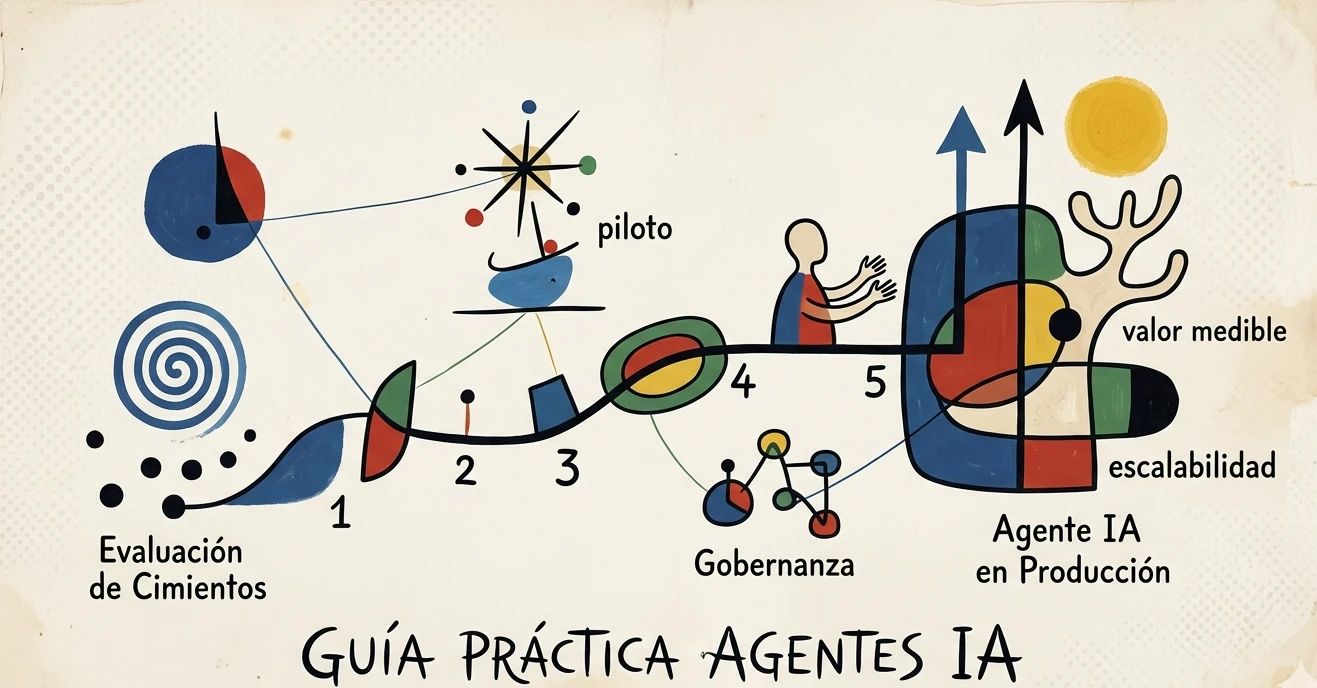

What You Will Learn in This Operational Guide
This is not a theoretical reflection on the future of artificial intelligence. It is a field manual designed for digital transformation leaders, CIOs, and operations managers who need measurable results. In the following sections, you will discover:
- How to assess whether your organization has the necessary foundations before investing.
- A 5-phase roadmap to move from an idea to a production-ready agent.
- A framework for selecting use cases with high impact and low initial risk.
- The specific mistakes that cause 95% of pilots to never scale.
- How to establish governance without slowing down innovation.
The goal is clear: to help you implement AI agents that generate measurable business value, not just internal headlines.
Visual Difference Between a Chatbot and an Autonomous AI Agent
The autonomous AI agent vs. the rigid chatbot: a Miró-inspired visual guide to understanding goal-oriented autonomy in business environments.
What AI Agents Really Are (and What They Are Not)
To successfully implement AI agents, the first step is eliminating terminology confusion. An enterprise AI agent is not simply an advanced chatbot or a basic task automation tool.
The fundamental difference is goal-oriented autonomy. While a chatbot answers questions within a predefined script and an RPA system follows rigid rules (“if X happens, do Y”), an AI agent understands a business objective (“qualify these leads according to their probability of closing”) and independently decides what steps to take, which tools to use, and when to request human assistance.
Key idea: AI agents do not replace outdated processes; they transform the way people work with them. If you automate a broken process with an agent, you will only break it faster and at a larger scale.
In practice, this means an agent can navigate across your CRM, ERP, and email systems, synthesize conflicting information, and execute transactional actions, always within the security boundaries you define. It is not magic; it is software engineering with language models acting as reasoning engines.
How to Implement AI Agents in the Enterprise: A 5-Phase Roadmap
Most failures do not happen because of poor technology, but because critical validation stages are skipped. This roadmap incorporates lessons from more than 50 documented enterprise deployments.
Phase 1: Diagnosis and Selection of the Right Use Case
Do not start with technology. Start with operational pain points. Identify processes that meet three criteria simultaneously:
- High repetitive volume.
- Accessible structured data.
- Controlled tolerance for errors.
Avoid overly ambitious “flagship” use cases for your first pilot. Experts recommend starting with internal support tasks: meeting summarization, data reconciliation between systems, or generating standardized report drafts. These cases allow organizations to validate infrastructure with minimal reputational risk.
Phase 2: Data Validation and Core Architecture
This is the stage where most projects fail. Gartner estimates that by the end of 2026, more than 60% of AI projects will be abandoned because organizations lack prepared data.
Before building anything, verify:
Accessibility: Are the data available through APIs or trapped inside legacy interfaces?
Quality: Is the data clean, labeled, and up to date?
Context: Will the agent have access to the information required to make informed decisions?
The basic architecture of an enterprise AI agent requires six integrated components:
- Reasoning model (LLM).
- Short-term and long-term memory.
- Toolset (APIs).
- Corporate knowledge base (RAG).
- Automated evaluation system.
- Human oversight layer.
Without one of these pillars, the agent will be unstable in production.
Phase 3: Building the Pilot with Human Oversight
Build using a “crawl, walk, run” approach. Use platforms such as Microsoft Copilot Studio or IBM watsonx Orchestrate, which enable visual prototyping and secure connections to enterprise systems.
Golden rule: Always keep humans in the loop during the pilot phase.
The agent should propose actions, but a professional should approve them before execution. This builds trust, creates training data to improve the model, and prevents security incidents.
Only when the human approval rate exceeds 95% over a sustained period should partial autonomy be considered.
Phase 4: Measuring Real Business Impact
Stop measuring “model accuracy” as a business success metric. What matters is operational outcomes.
Establish dual KPIs:
Technical Metrics
- Reliability (% of tasks completed without errors).
- Latency.
- Cost per transaction.
Business Metrics
- Hours saved per employee.
- Reduction in process cycle time.
- Improved conversion rates.
- Customer/internal user satisfaction.
For example, Grupo Bimbo measured the success of its audit agent by time reduction (-20%), not by abstract technical parameters. If you cannot connect the agent to an existing business metric, you are probably solving a problem nobody has.
Phase 5: Secure Scaling and Governance
Scaling is not simply deploying the same agent to more users. It requires dedicated management infrastructure.
You need an Agent Management Platform (AMP) that centralizes:
- Identity.
- Permissions.
- Observability.
- Agent lifecycle management.
Apply the principle of least privilege: each agent should only access the data and systems strictly required for its function.
Define clear escalation paths for situations outside the agent’s expected operating range. Establish regular behavioral audits, not only security audits.
Use Case Matrix: Where to Start According to Your Department
| Area | Candidate Process | Agent Type | Expected Impact | Complexity |
|---|---|---|---|---|
| Sales | Lead qualification and enrichment | Autonomous Sales Agent | +15% salesperson productivity | Medium |
| Customer Service | Technical post-sales support resolution | Cognitive Service Agent | -30% average resolution time | Medium-High |
| Finance | Bank reconciliation and reporting | Financial Analytics Agent | -60% repetitive manual work | Low-Medium |
| HR | Employee onboarding and internal policy responses | Employee Experience Agent | Saves 9 hours/month per manager | Low |
| Manufacturing | Dynamic production scheduling | Industrial Planning Agent | -12% cycle time | High |
| Legal/Compliance | Standard contract review | Document Analysis Agent | -75% initial review time | Medium |
Strategic note: Prioritize the “High Impact / Low-Medium Complexity” quadrant for your first two pilots. Early success creates budgetary and cultural momentum for more complex initiatives.
Checklist: Is Your Company Ready for AI Agents?
Before writing a single line of code or purchasing a license, validate these points. If you fail more than two, your priority is not implementing agents—it is preparing the organization.
- Defined processes: The target process is documented, standardized, and stable.
- Accessible and clean data: Functional APIs exist and data quality has been verified.
- Assigned owner: A business owner—not only a technical owner—is accountable for the agent’s results.
- Agreed success metrics: Business KPIs, baselines, and objectives have been defined.
- Security and governance policy: A framework exists for data handling, agent privileges, and human supervision.
- Scalable infrastructure: The architecture supports variable workloads and includes observability.
- Experimentation culture: Teams accept that pilots may fail and have time and budget to iterate.
- End-user training: Employees understand their new role as supervisors and orchestrators, not competitors of the agent.
Mistakes That Kill 95% of AI Agent Projects
The statistics are harsh: only around 2% of organizations successfully scaled AI agents into real production environments in 2025.
These are the recurring failure patterns:
- Automating broken processes: Using a 2026 agent to execute a 1995 process guarantees failure. Redesign first, automate second.
- One-size-fits-all governance: Treating an agent that creates internal summaries the same way as one that approves payments. Governance must match risk and autonomy level.
- Ignoring agent identity: Agents are non-human identities accessing systems. If you do not manage their credentials and permissions like those of a privileged employee, you create major vulnerabilities.
- Measuring vanity metrics instead of value: Celebrating “99% LLM accuracy” while the business process remains slow and expensive. Technology is the means, not the goal.
- Endless pilots without a production path: Experimenting indefinitely without clear graduation criteria. Define success and failure thresholds before starting.
Frequently Asked Questions About AI Agent Implementation
What is the difference between an AI Copilot and an autonomous AI agent?
An AI Copilot assists humans in real time by suggesting or completing tasks under direct supervision. An autonomous agent executes complete workflows from start to finish, with human involvement only for exceptions or critical approvals.
Many successful deployments begin as AI Copilots and gradually evolve toward greater autonomy.
How much does it cost to implement AI agents in a company?
Costs vary significantly depending on complexity and scale.
An internal pilot using low-code platforms may cost between €15,000 and €50,000, including licenses, integration, and team effort.
Enterprise deployments involving multiple systems and robust governance can start at €150,000–€300,000 during the first year.
The real cost is not the license—it is data preparation and organizational change.
Which departments achieve ROI fastest?
Sales (lead qualification), Customer Service (tier-1 resolution), and Finance (reconciliation/reporting) often show returns within 3–6 months because they combine high volume, structured data, and clear metrics.
Areas such as R&D or Strategy may have transformative potential but usually require longer validation cycles.
What legal and compliance risks exist?
The main risks include:
- Discriminatory decision-making caused by biased data.
- Sensitive information leaks due to excessive permissions.
- Responsibility issues caused by incorrect autonomous actions.
- Sector-specific regulatory compliance requirements (GDPR, financial, healthcare).
Mitigation requires proactive governance, not reactive responses.
Can I build AI agents without a data science team?
Yes, for standard use cases.
Platforms such as Copilot Studio, watsonx Orchestrate, and industry-specific solutions allow business analysts and functional teams to build agents.
For highly customized agents, complex integrations, or fine-tuned models, AI/ML engineers will be required.
The trend is to democratize construction while professionalizing governance.
Competitive Advantage Will Come from Learning How to Work with AI Agents
Implementing AI agents in the enterprise is not a technology project with a fixed end date. It is the beginning of a new organizational capability: designing, supervising, and scaling synthetic workforces responsibly.
Organizations that master this capability before competitors will not only become more efficient; they will develop fundamentally different cost structures and adaptation speeds.
However, the opportunity window is not measured in years, but in how quickly organizations learn to manage artificial autonomy with maturity.
The next step is not buying more technology. It is bringing business and technology teams together, applying this readiness checklist, and selecting the first use case that demonstrates tangible value within 90 days.
Everything else will follow, built on solid foundations.
External References Used
- McKinsey & Company. Why agents are the next frontier of generative AI.
- Microsoft Adoption. AI Agents Transformation Stories.
- Gartner. Applying uniform governance across AI agents will lead to failure.
- World Economic Forum & Capgemini. AI Agents in Action: Playbook for Trusted Adoption.
- Academic Study (QJE). Productivity Gains from AI Assistance.
- Microsoft Tech Community. Business Foundation for Agentic AI.
- Gravitee. AI Agent Management Platform Architect’s Guide.
- IBL AI. Enterprise AI Security: McKinsey Breach Analysis.
- Nestr. Dos and Don’ts Deploying First AI Agent.
Related Posts



2 Comments
Comments are closed.
[…] How to Implement AI Agents in the Enterprise: A Practical and Scalable Guide […]
[…] How to Implement AI Agents in the Enterprise: A Practical and Scalable Guide […]