



Many companies have already taken their first steps with artificial intelligence. They have tried generative AI tools, automated a specific task, or developed small internal projects to explore its potential.
However, there is a significant difference between experimenting with artificial intelligence and turning it into a strategic capability within the organization.
The real value emerges when AI stops being an isolated project and begins to integrate into the business’s critical processes: operations, customer service, knowledge management, production, data analysis, and decision-making.
To achieve this, companies need more than a new technology tool. They need a strategy that combines business vision, prepared data, the right architecture, and a new generation of solutions based on autonomous AI agents.
Companies that scale AI start with processes, not technology
One of the most common errors in artificial intelligence transformation programs is to start by selecting a technology before understanding where it can generate the greatest impact.
The usual question tends to be: “What AI solution can we implement?”
The organizations that achieve sustainable results frame a different question: “Which business processes have the greatest potential for improvement through artificial intelligence?”
This difference is fundamental.
An enterprise AI project must be connected to measurable objectives. It may be a matter of reducing operational times, improving the customer experience, accelerating decision-making, or freeing teams from repetitive tasks so they can focus on higher-value activities.
For example, an industrial company can use AI to anticipate machinery failures and reduce unplanned downtime. A services company can create an intelligent assistant connected to its internal documentation so that employees and customers can find relevant information in seconds.
Technology is the enabler, but the impact comes from correctly identifying where to apply it.
Autonomous AI agents are changing how companies are automated
For years, enterprise automation has been based primarily on predefined rules: if a given situation occurs, execute a specific action.
The arrival of autonomous artificial intelligence agents changes this approach.
An AI agent can interpret objectives, analyze information, use different data sources, and execute actions following established business rules.
This makes it possible to build systems capable of collaborating with people on complex processes.
An AI agent for operations, for example, could detect a deviation in a production process, consult historical data, analyze possible causes, and recommend an action to the responsible team. In certain scenarios, it could also automatically execute authorized actions.
The difference versus a traditional chatbot is significant: the agent does not limit itself to answering questions, but actively participates in solving problems.
This evolution is driving a new stage of enterprise artificial intelligence, known as Agentic AI, where organizations move from using intelligent tools to operating with systems capable of acting autonomously.
Enterprise data is the foundation of any advanced AI strategy
Many companies hold large volumes of information, but that does not mean they are ready to leverage it with artificial intelligence.
Data is usually distributed across ERP and CRM systems, internal applications, documents, historical databases, and department-specific platforms.
The challenge is not simply to store more information, but to turn that data into accessible, usable knowledge.
To scale AI solutions, organizations need to build a data architecture prepared for intelligent applications.
This means working on several levels:
- Create reliable, documented data sources that can be reused across different projects.
- Integrate information coming from different corporate systems.
- Connect documents and internal knowledge through intelligent search and information retrieval systems.
Enterprise AI-based knowledge systems become especially relevant here. These solutions allow employees to interact with corporate information in a natural way, consulting procedures, technical documentation, contracts, or internal bases through conversational language.
Instead of manually searching through thousands of documents, teams can access the relevant knowledge in a matter of seconds.
Intelligent automation enables transforming critical business areas
Artificial intelligence generates more value when applied to processes that involve complexity, high information volume, or a need for frequent decision-making.
Some clear examples are:
Operations and internal processes
AI agents can help automate administrative tasks, generate reports, analyze incidents, and coordinate workflows across different departments.
Production and maintenance
In industrial environments, the combination of sensors, historical data, and intelligent models makes it possible to anticipate problems before they affect production.
Predictive maintenance is an example of how AI can move from reacting to failures to preventing them.
Customer service
Intelligent systems can analyze requests, access relevant information, and provide personalized responses while maintaining the context of each interaction.
Knowledge management
Companies accumulate a huge amount of internal knowledge that often remains scattered.
AI-driven knowledge systems make it possible to turn that information into an asset accessible to the entire organization.
Security and governance are necessary to scale artificial intelligence
When a company begins deploying AI solutions in relevant processes, new needs related to security, control, and accountability emerge.
An enterprise AI system should be designed taking into account aspects such as:
- protection of sensitive information;
- permission control;
- traceability of decisions;
- human oversight;
- regulatory compliance.
Autonomous agents need clear boundaries. Not every decision should be fully automated, and each organization must define which actions a system can execute and which require human approval.
Trust is a determining factor for adoption. Employees and business owners need to understand how the AI works, what information it uses, and how it is controlled.
Companies that integrate governance from the start find it easier to expand their use cases later.
AI transformation requires combining technology and business knowledge
Artificial intelligence is not implemented solely from the technology departments.
The highest-impact projects usually involve multidisciplinary teams where data specialists, technology experts, and business area owners all take part.
A well-designed AI agent needs to understand the real context in which it will operate.
A production expert knows the problems of an industrial plant. A sales manager understands the customer’s needs. A technology specialist knows how to build a secure, scalable solution.
Combining these bodies of knowledge makes it possible to create systems that truly deliver value.
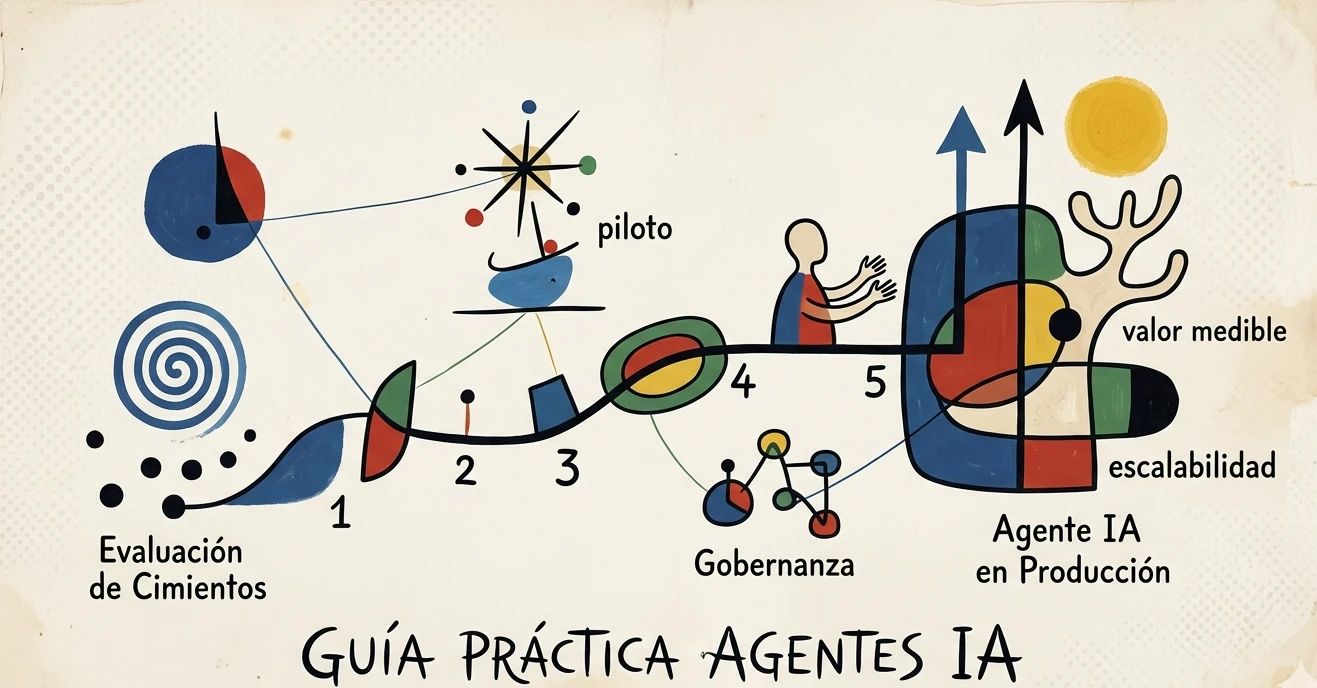
A practical roadmap for implementing enterprise AI
Organizations that want to move forward in an orderly way can structure their strategy in several phases.
In the first few weeks, the goal should be to identify specific opportunities, evaluate data availability, and select use cases with potential impact.
The first projects usually work best when they combine visible value with controlled complexity. For example, an internal assistant based on corporate knowledge can quickly demonstrate the potential of AI without requiring a full transformation of all the systems.
In a second phase, the company can expand the solution, connect new information sources, and integrate the AI into real operational processes.
Finally, the goal is to build a permanent capability: a reusable architecture, a deployment methodology, and a strategy that allows incorporating new AI agents across different areas of the business.
The next competitive advantage will be operating with intelligent systems
Artificial intelligence is moving from being an experimental technology to becoming a new operational layer within companies.
The most advanced organizations will not be those that simply use AI tools, but those able to integrate them deeply into their processes and turn their data and internal knowledge into intelligent capabilities.
Autonomous AI agents, intelligent automation, and enterprise knowledge systems represent a new way of working: more efficient, more connected, and with a greater capacity for adaptation.
The path from a first pilot to a real transformation requires strategy, but companies that begin building these capabilities now will be better positioned to compete in the coming years.
Related Posts



One comment
Comments are closed.
[…] 2. Generative AI chatbots. They are capable of understanding context and creating dynamic responses that simulate human natural language. They use LLMs to generate new content rather than retrieving preprogrammed responses. However, they can “hallucinate” —present false ideas as facts—, so they require oversight. […]