
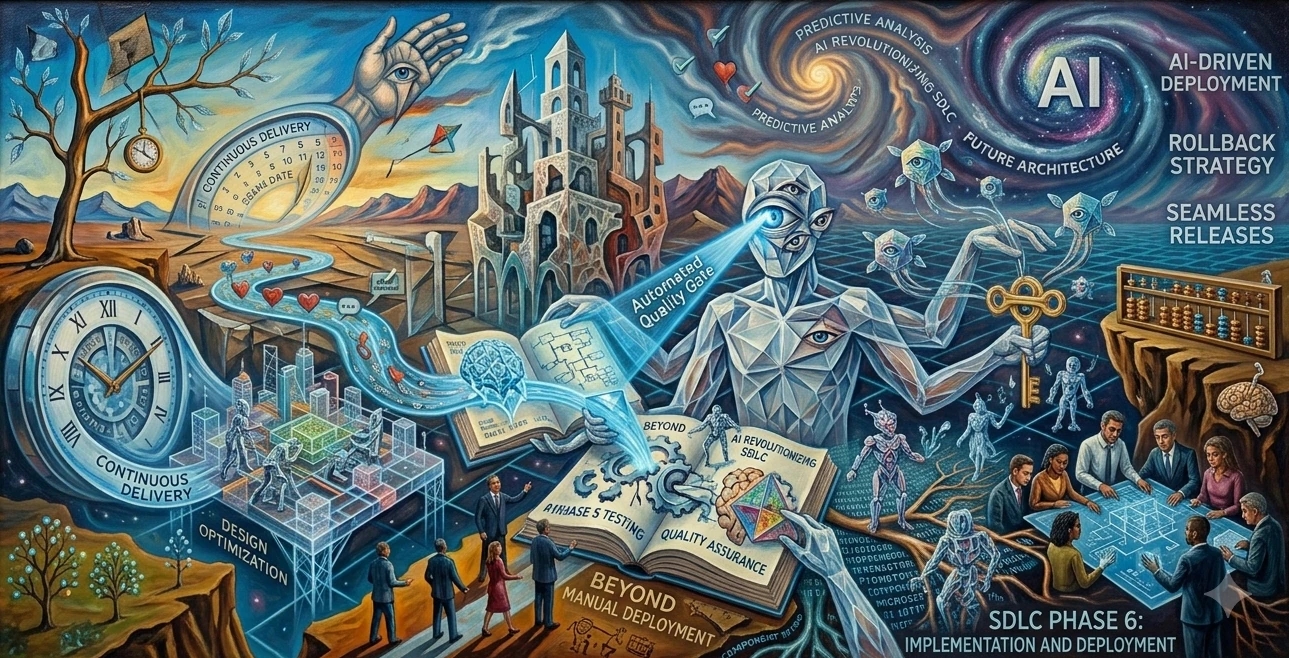

Phase 6 of the Software Development Life Cycle (SDLC) is the moment of truth. Implementation and Deployment is where all the planning, design, coding, and testing finally meet the real world. Historically, this phase has been the source of immense stress for engineering teams—famously giving rise to the industry joke of “Never Deploy on a Friday.”
Traditional deployment relied on rigid, manual checklists, fragile CI/CD scripts, and the anxious hope that the staging environment perfectly mirrored production. But in the era of Continuous Integration and Continuous Deployment (CI/CD), speed is mandatory, and human oversight is no longer enough to guarantee safety at scale.
Enter Artificial Intelligence. AI is transforming deployment from a high-stakes, manual handoff into a seamless, autonomous, and self-correcting process. Here is a deep dive into how AI is reshaping the Implementation and Deployment phase, followed by the top tools to power this transformation.
The Deep Dive: AI’s Role in Modern Deployment
The new generation of AI-driven DevOps and AIOps tools doesn’t just execute deployment scripts; it understands the infrastructure, predicts pipeline failures, and monitors production health in real-time. This transformation unfolds across four critical dimensions:
1. Intelligent CI/CD Pipeline Optimization and Predictive Failures
Build and deployment pipelines are complex, and a single failure can halt the entire release train. AI analyzes historical pipeline data to identify bottlenecks, automatically optimizing build times by parallelizing tasks or caching dependencies more efficiently. More importantly, AI introduces Predictive Build Failure Analysis. By analyzing the code changes, commit messages, and historical failure patterns, AI can predict if a pipeline is likely to fail before it even runs, alerting developers to fix the issue locally and saving valuable compute resources and time.
2. Infrastructure as Code (IaC) Generation and Drift Detection
Provisioning the underlying infrastructure for a deployment is a critical part of implementation. AI assistants can now generate complex Infrastructure as Code (Terraform, Ansible, CloudFormation) from natural language prompts. Furthermore, AI continuously monitors the live infrastructure for configuration drift (when the actual environment diverges from the code). It can automatically detect security misconfigurations or performance bottlenecks in the IaC scripts before they are applied, ensuring that the deployment target is secure and optimized.
3. Autonomous Release Strategies and “Go/No-Go” Decisions
Modern deployments use advanced strategies like Canary releases or Blue/Green deployments to mitigate risk. AI takes this a step further by acting as an autonomous release manager. During a canary rollout, AI continuously analyzes real-time telemetry (latency, error rates, CPU usage) of the new version compared to the old one. If the AI detects a statistically significant anomaly, it can automatically halt the rollout or trigger a rollback without human intervention, turning a potential outage into a non-event.
4. Real-time Observability and Automated Incident Triage
The moment code hits production, the deployment phase transitions into immediate verification. AI-driven observability tools ingest massive streams of logs, metrics, and traces. Instead of overwhelming engineers with thousands of alerts, AI performs intelligent noise reduction and root cause analysis. It correlates a spike in 500 errors directly to the specific microservice and code commit deployed minutes ago, instantly providing the development team with the exact context needed to remediate the issue.
Top AI Tools for SDLC Phase 6: Implementation and Deployment
To achieve zero-downtime, high-velocity releases, DevOps and platform engineering teams need to integrate AI into their delivery pipelines. Here is a curated list of AI platforms that excel in the Deployment phase:
1. Harness (with AIDA)
- Best for: End-to-end AI-driven CI/CD and release management.
- How it helps: Harness is a modern software delivery platform powered by AIDA (Artificial Intelligence Development Assistant). AIDA helps generate CI/CD pipelines via natural language, automatically identifies the root cause of pipeline failures, optimizes cloud costs during deployment, and provides intelligent insights into deployment health and developer productivity.
2. Spacelift / env0
- Best for: Infrastructure as Code (IaC) management and policy enforcement.
- How it helps: These platforms manage Terraform, CloudFormation, and Pulumi workflows. They use AI and policy-as-code to automatically detect misconfigurations, security vulnerabilities, and cost overruns in infrastructure changes before they are deployed. They ensure that every implementation is compliant and structurally sound.
3. Datadog (with Bits AI) / Dynatrace (with Davis AI)
- Best for: Real-time observability, deployment verification, and AIOps.
- How it helps: Both are leaders in observability. Datadog’s Bits AI and Dynatrace’s Davis AI act as autonomous SREs (Site Reliability Engineers). During a deployment, they automatically correlate anomalies, pinpoint the exact root cause of post-deployment issues, and can even suggest or execute remediation steps, ensuring that implementation errors are caught and resolved in minutes.
4. Sentry (with Seer AI)
- Best for: Post-deployment error tracking and automated triage.
- How it helps: Sentry is crucial for the immediate aftermath of a deployment. Its AI engine, Seer, automatically groups and triages new errors that appear after a release. It analyzes the stack trace, suggests the exact code commit that caused the bug, and even recommends a fix, drastically reducing the Mean Time to Resolution (MTTR) for production issues.
5. Kubiya
- Best for: Conversational DevOps and automated infrastructure tasks.
- How it helps: Kubiya is an AI-powered DevOps agent that allows engineers to interact with their infrastructure using natural language via Slack or Teams. Instead of writing complex CLI commands to troubleshoot a deployment or provision a quick resource, developers can simply ask the AI agent, which then executes the necessary scripts securely in the background.
6. PagerDuty (with AIOps)
- Best for: Incident response and alert noise reduction during rollouts.
- How it helps: If a deployment goes wrong, PagerDuty’s AIOps engine kicks in. It intelligently correlates thousands of raw alerts into a single, actionable incident. It identifies the likely cause (e.g., “Database migration failed during v2.4 deployment”) and automatically pages the right engineering team with all the necessary context, preventing alert fatigue during critical rollouts.
7. GitLab Duo / GitHub Copilot for Workflows
- Best for: CI/CD script generation and pipeline debugging.
- How it helps: Integrated directly into the version control platforms, these AI tools help DevOps engineers write complex
.gitlab-ci.ymlor GitHub Actions workflows using natural language. If a deployment pipeline fails, the AI can analyze the logs and automatically suggest the exact code fix to get the pipeline green again.
The Bottom Line
Phase 6 of the SDLC is no longer about crossing your fingers and hoping the deployment works. AI has shifted the paradigm from manual, high-stakes releases to autonomous, data-driven implementations.
By integrating AI into your deployment phase, development departments can achieve true Continuous Deployment with confidence. AI eliminates the toil of pipeline maintenance, secures the infrastructure before it goes live, and acts as an automated safety net the second code reaches production.
Stop treating deployment as a bottleneck or a source of anxiety. Embrace AI-driven DevOps, and turn your implementation phase into a seamless, high-velocity engine that delivers value to your users safely and continuously.