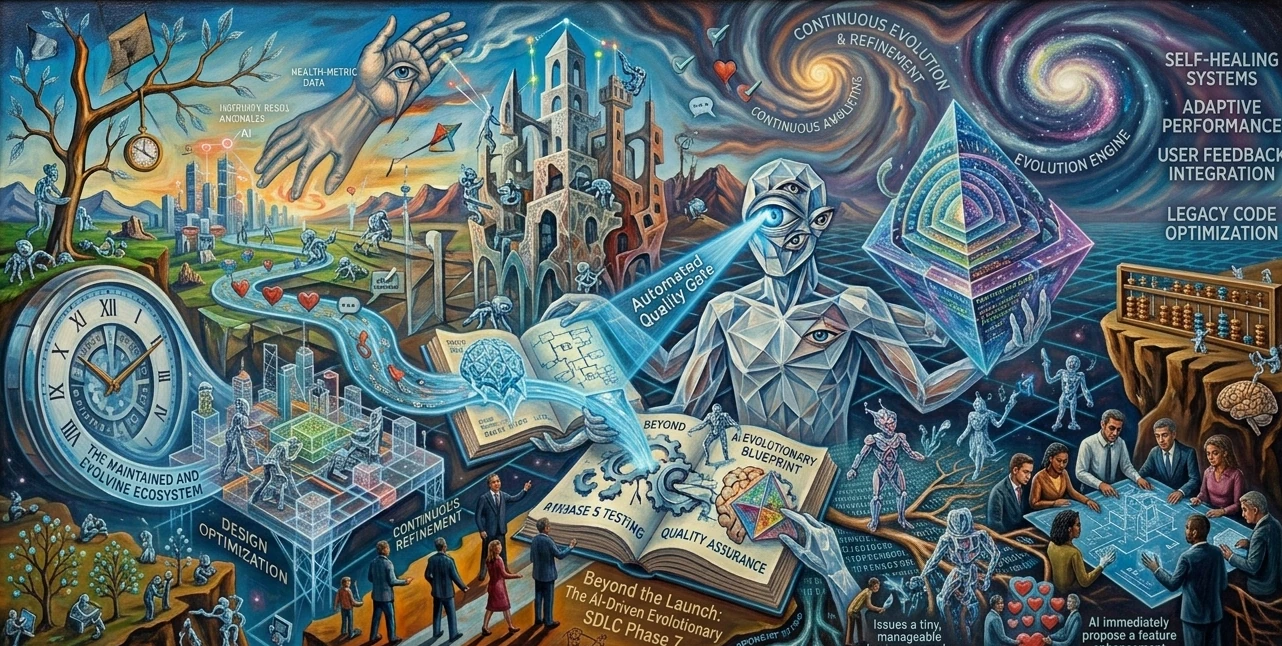

In the Software Development Life Cycle (SDLC), there is a common misconception that Phase 7 is the “end” of the journey. In reality, Maintenance is the longest, most expensive, and most critical phase of all. Industry studies show that maintenance can account for 60% to 80% of the total lifecycle cost of a software product.
Historically, maintenance has been a reactive, unglamorous graveyard for engineering talent. Developers spend their days fighting fires, deciphering undocumented legacy code, chasing down elusive bugs reported by users, and drowning in a sea of alert fatigue.
Enter Artificial Intelligence. AI is fundamentally transforming software maintenance from a reactive, manual chore into a proactive, autonomous, and continuous evolution engine. Here is a deep dive into how AI is reshaping the Maintenance phase, followed by the top tools to keep your software healthy.
The Deep Dive: AI’s Role in Modern Maintenance
The new generation of AI-driven maintenance tools doesn’t just monitor the system; it understands the codebase, predicts future failures, and actively participates in keeping the software healthy. This transformation unfolds across five critical dimensions:
1. Autonomous Bug Fixing and Self-Healing Systems
When a critical bug is discovered in production, the traditional path involves triage, assignment, reproduction, coding, testing, and deployment. AI compresses this cycle dramatically. Advanced AI agents can now ingest production crash logs or user bug reports, trace the execution path through the codebase, identify the root cause, write the fix, generate the corresponding tests, and automatically open a Pull Request (PR). In some cases, for known, low-risk issues, the AI can even auto-merge and deploy the hotfix without human intervention.
2. Proactive Technical Debt Management
Technical debt is the silent killer of software longevity. Left unchecked, it slows down development to a crawl. AI acts as an automated code health inspector. By continuously analyzing the codebase, AI can identify “hotspots” of high complexity, duplicated logic, and anti-patterns. More importantly, it quantifies the technical debt in business terms (e.g., “This module will take 3x longer to modify than average”) and prioritizes refactoring efforts based on actual risk and business impact, rather than just code aesthetics.
3. Predictive AIOps and Anomaly Detection
Traditional monitoring relies on static thresholds (e.g., “Alert me if CPU > 90%”). This leads to massive alert fatigue. AIOps (Artificial Intelligence for IT Operations) shifts this to predictive maintenance. By analyzing historical telemetry, AI learns the normal behavioral baseline of the system. It can predict that a specific microservice will run out of memory in exactly 48 hours due to a slow memory leak, or that a database connection pool will exhaust during an upcoming traffic spike, allowing teams to fix the issue before the user is ever impacted.
4. Intelligent Security Patching and Dependency Management
Modern software is built on a massive foundation of open-source dependencies. When a new vulnerability (CVE) is disclosed, teams traditionally face a nightmare of upgrading libraries, fearing breaking changes. AI solves this through Reachability Analysis. Instead of blindly alerting on every vulnerable library, AI analyzes your specific codebase to determine if your application actually uses the vulnerable code path. It then auto-generates the upgrade PR, runs the test suite to ensure no breaking changes occurred, and presents a safe, verified patch to the developers.
5. Living, Auto-Syncing Documentation
Documentation is the first casualty of software maintenance; it quickly becomes outdated and useless. AI is solving the “rotting docs” problem by creating Living Documentation. AI tools continuously monitor code changes and automatically update architectural diagrams, API references, and inline code comments. When a developer changes a database schema, the AI instantly updates the corresponding README and data dictionary, ensuring the documentation is always a perfect reflection of the live code.
Top AI Tools for SDLC Phase 7: Maintenance
To keep your software resilient, secure, and evolving, engineering teams need to integrate AI into their long-term maintenance strategy. Here is a curated list of AI platforms that excel in the Maintenance phase:
1. Snyk (with DeepCode AI & Reachability)
- Best for: Intelligent vulnerability management and automated dependency patching.
- How it helps: Snyk goes beyond basic vulnerability scanning. Its AI performs deep reachability analysis to tell you if a vulnerable open-source package is actually executed in your code. It then uses AI to automatically generate fix PRs, upgrading the dependency while ensuring your application doesn’t break, drastically reducing the time spent on security maintenance.
2. Codacy (with AI Code Analysis)
- Best for: Automated technical debt quantification and code health monitoring.
- How it helps: Codacy continuously analyzes your repository to track code quality and technical debt over time. Its AI engine not only flags complex, duplicated, or poorly structured code but also provides actionable, AI-generated suggestions on how to refactor it. It helps engineering managers prioritize which legacy modules need immediate attention.
3. Swimm
- Best for: Auto-syncing, living documentation.
- How it helps: Swimm is a knowledge management tool built for developers. Its AI continuously monitors your codebase and automatically flags documentation snippets that are out of sync with the actual code. It can even auto-generate documentation for new code and update existing docs when the underlying logic changes, ensuring your team never has to work with outdated manuals.
4. BigPanda / Moogsoft
- Best for: AIOps, event correlation, and predictive alerting.
- How it helps: These AIOps platforms ingest millions of alerts from various monitoring tools. Their AI algorithms correlate these noisy alerts into a few actionable incidents, identifying the true root cause. They also use predictive analytics to spot degrading system health trends before they result in an outage, shifting the team from reactive firefighting to proactive prevention.
5. Mend.io (formerly WhiteSource)
- Best for: End-to-end open-source security and automated remediation.
- How it helps: Mend.io specializes in securing the software supply chain. Its AI-driven remediation engine automatically fixes vulnerabilities in open-source libraries. It doesn’t just bump the version number; it intelligently resolves transitive dependency conflicts and generates fully tested, ready-to-merge pull requests, saving developers hours of manual dependency resolution.
6. Kiuwan
- Best for: Software intelligence and architectural maintenance.
- How it helps: Kiuwan uses AI to analyze the structural integrity of your software. It maps out the entire architecture, identifies hidden dependencies, and calculates a precise “Technical Debt Ratio.” Its AI suggests the optimal refactoring paths to improve maintainability, making it an invaluable tool for teams managing large, complex, or legacy enterprise applications.
7. Claude Code / GitHub Copilot (in Legacy Refactoring Mode)
- Best for: Understanding, explaining, and modernizing legacy code.
- How it helps: When maintaining older systems, developers often face “black box” code written by engineers who left years ago. CLI agents like Claude Code or Copilot can ingest these massive, undocumented legacy files and instantly explain their business logic, generate missing unit tests, and suggest modern refactoring patterns (e.g., “Rewrite this 5-year-old Java 8 class using modern Java 21 features while preserving the exact business logic”).
The Bottom Line
Phase 7 of the SDLC is not the end of the software’s life; it is where the software truly lives and evolves. Historically, maintenance has been a drain on resources, bogged down by technical debt, elusive bugs, and outdated documentation.
By integrating AI into your maintenance phase, development departments can shift from a posture of reactive survival to proactive evolution. AI takes on the heavy lifting of deciphering legacy code, patching vulnerabilities, and correlating alerts, freeing your engineers to focus on what truly matters: building new features, improving architecture, and delivering continuous value to the user.
Software maintenance is no longer about keeping the lights on. With AI, it’s about building a self-optimizing, resilient system that continuously improves itself long after the initial launch.