
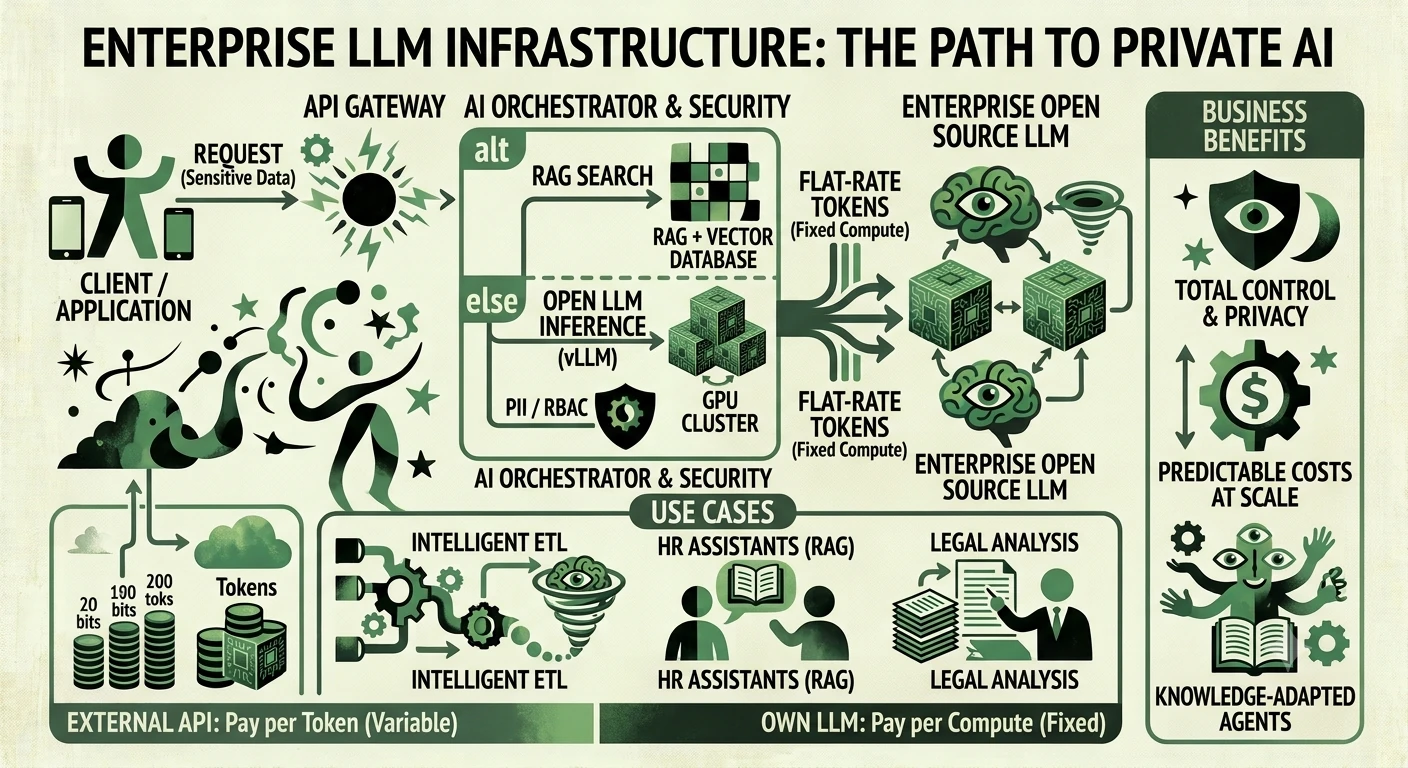

Companies are shifting from consuming artificial intelligence via external APIs to building their own internal capabilities based on private LLMs. This evolution reduces costs, improves privacy, processes large volumes of information, and deploys intelligent agents tailored to corporate knowledge. We are entering a new stage of technological maturity where having a proprietary enterprise LLM infrastructure is no longer an extravagance, but the core of competitive advantage.
For CIOs, CTOs, and digital transformation leaders, the challenge is no longer experimenting with AI, but scaling it. Just as with corporate Internet adoption, the leap to mass adoption didn’t happen simply because the technology existed, but because of how companies were able to consume it. Today, we are witnessing a similar phenomenon driven by private language models.
What is an Enterprise LLM Infrastructure?
An enterprise LLM infrastructure is a technology environment controlled by the organization—whether on-premise or in a private cloud—that allows for the execution, orchestration, and governance of large language models without relying exclusively on external API providers.
This AI architecture is not limited to hosting a model; it integrates security capabilities, request routing, data management, and observability. The goal is to provide a cross-cutting enterprise cognitive layer capable of interacting with internal systems (ERP, CRM, document databases) and processing sensitive information without compromising AI governance or corporate privacy.
Having your own corporate AI stack means the organization controls both the model and the data it interacts with, enabling generative AI in production with guarantees of regulatory compliance and budget predictability.
Why Are Companies Moving Away from Relying Solely on External APIs?
In the early years of the Internet, access was measured by connection minutes. Companies had to rationalize the time their employees spent connected because every minute had a direct cost. The real productivity boom arrived with flat-rate pricing. When organizations stopped worrying about the cost of each connection, the Internet became an essential enterprise infrastructure, integrating into every business process.
Generative AI is following exactly the same path. Today, consuming models through external APIs works like the old pay-per-minute model: you are billed for every token processed. This model is excellent for initial experimentation or isolated use cases, but it penalizes corporate-scale ambition. If a company wants its employees to use intelligent assistants dozens of times a day, or if it needs to process millions of historical documents, the cost becomes a psychological and financial barrier.
Exclusive reliance on external APIs also poses governance and privacy challenges. Sending sensitive customer data or intellectual property to third parties is not always viable. Therefore, organizations are evolving toward a hybrid model, combining the best of both worlds: proprietary APIs for complex reasoning and private models for heavy, massive workloads.
The “Flat Rate for Tokens”: The New Economic Model of AI
The ability to deploy open-source LLMs for enterprises allows us to create what we call the “flat rate for tokens.” By assuming the cost of the underlying computing capacity (servers and GPUs) instead of paying for each individual interaction, the company gains virtually unlimited AI capacity for its internal processes.
This economic paradigm shift is revolutionary. When the marginal cost of processing a new token approaches zero, teams stop asking for permission to innovate. Friction is eliminated, bottom-up technological innovation is fostered, and AI is democratized. Private AI infrastructure allows organizations to plan their growth without the fear of unexpected variable bills, transforming AI from an unpredictable operational expense into a controlled strategic asset.
Open Source LLMs for Enterprises: A Strategic Alternative
The natural evolution toward proprietary infrastructure would be impossible without the unstoppable maturity of open-source language models. Ecosystems like Meta’s Llama, Mistral, or Qwen have demonstrated performance levels that rival proprietary models in many corporate tasks, especially when subjected to enterprise fine-tuning.
Using open-source LLMs for enterprises offers unmatched flexibility. Organizations can choose the model size that best fits their latency and hardware needs, customize it with their own knowledge, and update it on their own schedule. This makes private models a fundamental strategic piece for building differentiated capabilities that competitors cannot replicate simply by subscribing to an external service.
Reference Architecture of an Enterprise AI Platform
For a CTO to evaluate this transition, it is necessary to understand how this technology materializes. A robust enterprise LLM architecture is not simply a model hosted on a server; it requires a systemic design that guarantees scalability, security, and efficiency.
Architecture Components
- Users and Applications: The access point for employees, corporate copilots, or internal systems.
- AI Gateway: A gateway that manages routing, rate limiting, load balancing, and request auditing.
- Authentication and Security: Role-based access control (RBAC) and masking of sensitive data (PII) before it reaches the model.
- AI Orchestrator: The brain that decides whether a query requires enterprise RAG, a database search, or direct inference.
- RAG + Vector Database: Retrieval-Augmented Generation systems that connect the LLM with corporate documentation in real-time.
- Inference Engine (vLLM / TensorRT-LLM): The software that optimizes model execution on GPUs.
- GPU Cluster: The hardware (proprietary or cloud) that provides computing power.
- Model Registry and LLMOps: Management of the model lifecycle, versions, and fine-tuning.
- Observability: Monitoring of latency, response quality, hallucinations, and resource usage.
Incorporating a proprietary AI layer over the existing enterprise cloud architecture is a logical technological evolution. The cloud providers where many companies already operate (AWS, Microsoft Azure, Google Cloud, and Alibaba Cloud) facilitate this path through integrated services for cloud LLM deployment, allowing open-source models to be deployed on managed Kubernetes clusters with a couple of clicks.
Comparison: External API vs. Proprietary LLM
For technology leaders, the decision is not exclusive, but strategic. Here is how both approaches compare:
| Aspect | External API (Proprietary) | Proprietary LLM (Open Source on proprietary infrastructure) |
|---|---|---|
| Cost | Variable per consumed tokens. Impossible to predict at scale. | Fixed infrastructure. Marginal cost per token close to zero. |
| Privacy | Data leaves the organization (unless specific agreements are in place). | Total internal control. Data never leaves the corporate environment. |
| Customization | Limited to system prompts or small, expensive fine-tunings. | High. Possibility of deep fine-tuning with proprietary data. |
| Scalability | Depends on the provider and is subject to quota limits. | Under the organization’s total control (horizontal GPU scaling). |
| AI Governance | Partial. Subject to the provider’s policies. | Complete. Auditing, filters, and absolute control of outputs. |
When Does It Make Sense to Build a Proprietary LLM?
Building a private LLM environment requires initial investment and technical talent. Therefore, it is crucial to know how to identify the right moment.
It makes sense when the organization presents:
✅ Millions of historical or internal documents that need to be processed.
✅ High volume of internal queries from employees or customers.
✅ Handling of highly sensitive data (intellectual property, finance, healthcare).
✅ Need for deep customization with corporate knowledge.
✅ Daily, cross-departmental use of AI by the workforce.
It does not make sense (at least initially) when:
❌ There are few users or usage is sporadic.
❌ The company is in initial experimentation phases without defined use cases.
❌ Tasks requiring extreme reasoning are needed, which open-source models do not yet cover at the level of the most advanced APIs.
Use Cases: From Smart ETL to Enterprise AI Agents
The true transformation occurs when infrastructure is placed at the service of the business. The transition from small experiments to real use cases enables unprecedented enterprise automation with AI. The key idea is that LLMs allow companies to convert information accumulated over years into actionable knowledge.
Artificial Intelligence for ETL Processes
Perhaps the most transformative use case is the new generation of smart ETL (Extract, Transform, Load) processes. Historically, ETL moved structured data. Today, AI for ETL processes allows for the processing of the immense layer of corporate unstructured data.
- Automatic Extraction: A private LLM can extract information from business documents (contracts, invoices, delivery notes) without rigid templates.
- Data Transformation: Converts free text into JSON structures or relational tables to feed ERP or CRM systems.
- Intelligent Classification: Reads documents, understands their semantic context, and categorizes them dynamically.
- Enrichment and Metadata: Performs automatic database enrichment by adding tags that made previous search systems unviable.
Practical Business Examples
- Legal Department
- Before: Lawyers manually reviewing thousands of contracts to find risk clauses.
- After: A private LLM analyzes 500,000 contracts in hours, extracts specific clauses, assesses the risk level, and generates automatic alerts.
- Human Resources
- Before: Employees repeatedly asking about vacation policies, leave, or benefits.
- After: An internal AI assistant, connected via enterprise RAG to HR policies, responds instantly with exact references to the internal manual.
- Operations and Logistics
- Before: Information distributed across emails, PDFs, and legacy systems.
- After: Enterprise AI agents consult the ERP, CRM, and documentation simultaneously to predict supply chain delays and automate communication with suppliers.
How to Deploy Private Generative AI in a Company
The path to enterprise LLM deployment is more accessible today than ever. The key is to lean on the existing cloud architecture. If an organization already uses AWS, Azure, or Google Cloud, it can leverage services like Amazon SageMaker JumpStart, Azure Machine Learning, or Vertex AI to deploy open-source models on managed GPU clusters using Kubernetes.
This approach allows you to:
- Keep data within the security perimeter of the corporate network or VPC.
- Scale computing resources (GPUs) according to demand.
- Integrate the model with the existing vector database to implement RAG.
- Establish an LLMOps layer to monitor model performance and degradation.
Costs: External API vs. Proprietary Infrastructure
The enterprise GenAI market is experiencing exponential growth, and open-source models are drastically reducing inference costs.
Paying $10 for every million tokens on an API might seem cheap at first. However, if a company of 5,000 employees makes an average of 50 daily queries that process 2,000 tokens each, the monthly API cost skyrockets to tens of thousands of dollars. With a private AI infrastructure, the organization assumes a fixed cost for the GPU cluster. Beyond a certain usage threshold, the per-token cost of the proprietary model is up to 90% lower than that of the external API, more than justifying the technological investment.
The Future of Enterprise Artificial Intelligence
The convergence between the maturity of private language models, the capacity of cloud providers to host them, and the real needs of companies has created the perfect ecosystem. Organizations that understand that their accumulated information, processed through their own models, is an incalculable asset will be the ones leading their respective markets.
The question for organizations is no longer whether they will use artificial intelligence, but whether they will have the internal capacity to govern it, scale it, and integrate it into their critical processes. Building a proprietary LLM infrastructure is the definitive step to ensure that AI stops being an external tool and becomes the true engine of enterprise productivity and sustainable innovation.
Frequently Asked Questions (FAQ) about Enterprise LLM Infrastructure
What is an enterprise LLM infrastructure?
It is a technology environment composed of hardware (usually GPUs), orchestration software (MLOps, AI Gateway), and language models (open-source or proprietary) deployed within an organization’s control perimeter. Its objective is to provide generative AI capabilities securely, scalably, and with controlled costs.
Is it cheaper to host your own LLM than to use an API?
It depends on the volume. For low or sporadic use, external APIs are more economical. However, for companies that process large volumes of documents or have thousands of daily active users, hosting their own LLM allows for a drastic reduction in AI API costs, as the marginal cost of processing additional tokens approaches zero.
What open-source models can companies use?
There are several high-performance options with permissive licenses for commercial use. The most prominent include the Llama 3 family (from Meta), the Mistral and Mixtral models, and Qwen (from Alibaba). These models can be downloaded and deployed on the company’s own infrastructure.
What GPU does a company need to run an LLM?
It depends on the size of the model. For models of 7B to 13B parameters, professional consumer GPUs like the NVIDIA A10G or RTX 4090 may be sufficient. For larger models (70B parameters), data-center grade GPUs like the NVIDIA A100 or H100 are required, often grouped in clusters to allow for sharding (splitting the model across multiple cards).
How to protect enterprise data when using generative AI?
The best way is to deploy private models within a Virtual Private Cloud (VPC) or on on-premise servers. Additionally, LLM security layers must be implemented, such as PII (Personally Identifiable Information) masking before inference, role-based access control (RBAC), and log auditing through an AI Gateway.
What is the difference between RAG and fine-tuning?
Fine-tuning involves retraining the model with specific data to alter its behavior or instill deep knowledge in it; it is ideal for repetitive and specific tasks. RAG (Retrieval-Augmented Generation), on the other hand, does not modify the model but provides it with real-time context extracted from a vector database. RAG is faster to implement, allows information to be updated instantly, and is the current standard for interacting with corporate documentation.