

Let’s be honest. The last time we talked about implementing Artificial Intelligence in your business, you dropped the classic: “There’s no budget, the ROI isn’t clear, and the tools are way too expensive.”
Fine. I accept the argument.
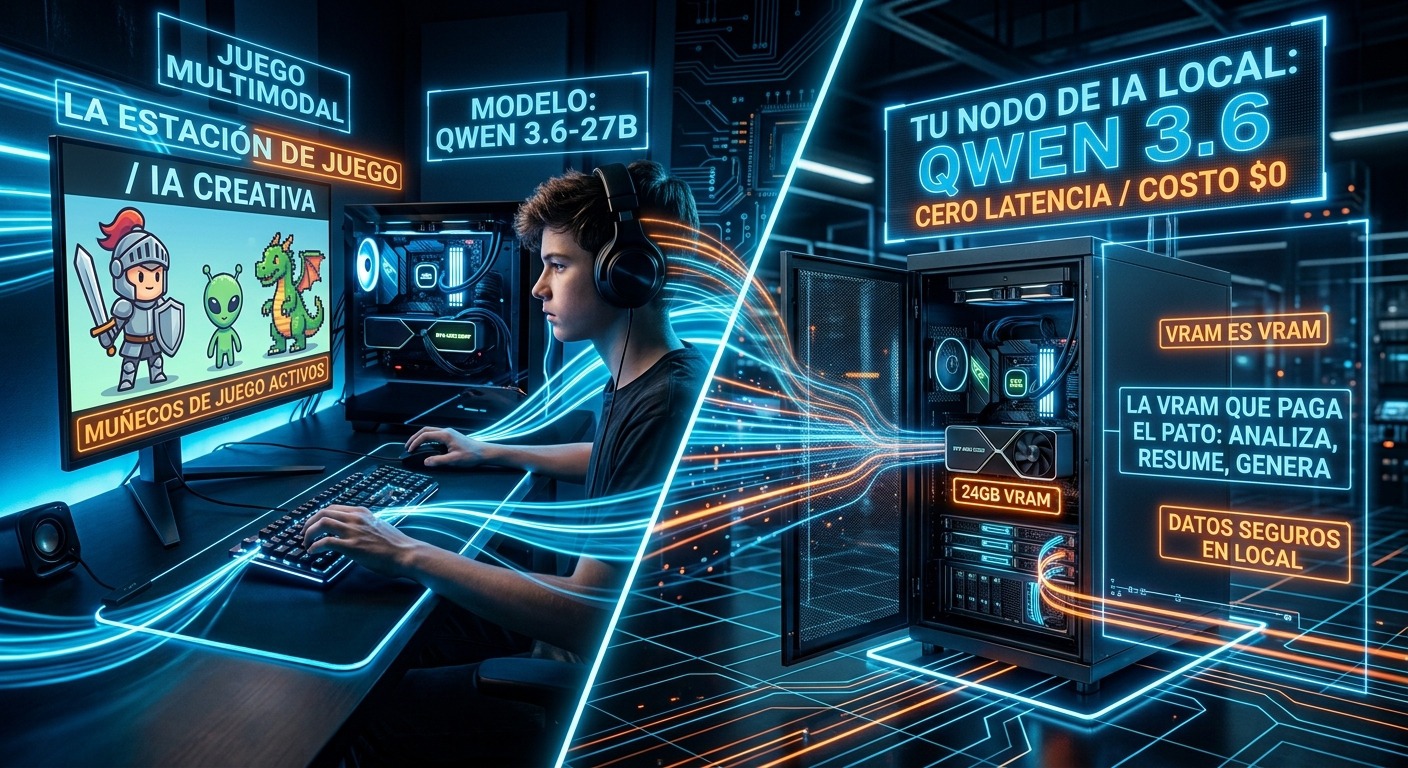
But then I visit your home, I look at your kid’s setup, and I find an RTX 4080 Super and an OLED monitor so the kid can play Black Myth: Wukong or Cyberpunk 2077 in 4K at 60 FPS without dropping a single frame. You’ve sunk 2,500 or 3,000 euros into silicon so your son can hunt monsters or explore Night City.
And this is where I have to ask you an uncomfortable question: If you have the money to render the pores on a video game character’s face, why do you say you don’t have the money to process your company’s data?
They sold you on the idea that AI requires infrastructure that only NASA has. False. They sold you on the idea that you have to pay for every single query. False.
Take a look at this table. It’s not the spec sheet of a gaming PC — it’s the map to your next competitive advantage:
| Your kid’s “Toy” (4K / 60 FPS) | The VRAM you’re paying for | Your Local “AI Department” (Qwen 3.5 / 3.6 Open Source Models) | What your company can do (Modalities) |
|---|---|---|---|
| Monster Hunter Wilds / Horizon | 12 – 16 GB | Qwen3.5-14B / Qwen3.6-8B/9B | Read, analyze, and summarize documents, blueprints, and images (Vision). |
| Black Myth: Wukong / Cyberpunk / Star Wars | 16 – 24 GB | Qwen3.6-27B / Qwen3.5-35B-A3B (MoE) | Analyze Text, Image, Audio and Video. Context windows of up to 1M tokens. |
| GTA VI | 24 GB | Qwen3.5/3.6-35B-A3B (MoE) | Complex local multimodal analysis. The holy grail of edge AI. |
See the trick? VRAM is VRAM. The graphics card doesn’t care at all whether it has to compute the reflections of ray-tracing in Star Wars Outlaws or whether it has to process a one-million-token context window to review your legal department’s contracts, transcribe your sales meetings, or analyze the footage from your warehouse security camera.
The hardware your kid uses to escape reality is exactly the same hardware your company needs to understand it.
The great lie of APIs: bleeding your cash flow month after month
“But we already use AI, we pay for the API of the month.”
Yes, and you’re leaving your profit margin on the road. Consuming AI through APIs and pay-per-token is like renting an apartment for life: every single month, the mortgage.
If your company processes volume, the APIs will bleed you dry.
- Want the AI to analyze the 4 hours of video from your factory cameras to detect bottlenecks? The API will charge you for every frame processed.
- Want to feed in the audio of all your sales team’s calls to extract objections? The API will charge you for every minute of transcription and analysis.
- Want it to read the 500 PDFs in your corporate knowledge base? The API will charge you for every input and output token.
The API model is designed so that you take on the operational risk (OPEX) and they collect the rent.
The mindset shift: from gaming PC to edge AI node
Open source models like the Qwen 3.5 and 3.6 family have broken the market. They are natively multimodal (they understand text, image, audio, and video) and they run locally.
What does that mean in plain terms?
- Zero marginal cost. Once you buy the GPU (yes, the same one your kid wants for GTA VI), processing 1 token or 10 million tokens costs you the same: the electricity.
- Zero data leaks. Your sensitive information doesn’t leave your office to go to servers in California.
- Zero latency. The AI responds in milliseconds because it’s on your local network, not bouncing around the internet.
The next time your kid asks you to upgrade their PC to stay “on the latest,” or you yourself look at that 24 GB RTX 4090 with envy, don’t just look at the FPS.
Look at those 24 GB of VRAM and tell me you really don’t have a budget for AI. Because what you have — what you’re missing — is the business vision to realize that the best enterprise AI infrastructure isn’t in the cloud; it’s hidden inside the tower of a gaming PC.
Look, I’m going to be brutally honest with you.
If you’ve reached the end of this text and you’re still thinking “there’s no budget” for AI, the problem isn’t your income statement. The problem is that you’re paying the toll of innovation for not knowing where to look.
Stopping the API bleeding and building your own local AI infrastructure isn’t black magic; it’s well-applied engineering. And for that you don’t need to hire a team of Silicon Valley data scientists; you need someone who knows which buttons to press so those open-source models work for your business, on your network, with your hardware.
If you’re tired of throwing money at tokens every time someone asks your website’s chatbot a question, and you want to see your company process data, analyze video, and automate processes without a cloud invoice landing on your desk at the end of the month…
Call me.
I’m not going to sell you smoke, nor am I going to ask for a six-figure budget or an eight-month implementation project. We’re going to look at your hardware, we’re going to look at your bottlenecks, and we’re going to build your local AI. Fast, rough, and profitable.
Your competition is already stopping renting their intelligence. The only question is whether you’ll be the one who implements AI in your company, or the one complaining at the next industry convention that margins are getting narrower every year.
Shall we talk?
P.S.: If your kid asks for the next generation of graphics cards when it comes out, buy it for them. But this time, put it on your company’s balance sheet as a “local AI inference server.” Write it off and get to work.